
The short answer is no. Moderna has not cured melanoma. But something important has happened. On 19 August 2026, Moderna and Merck announced positive results from their Phase 3 trial. According to the companies, a therapeutic vaccine designed for each person’s tumour, given with the immunotherapy pembrolizumab, delayed the return of melanoma and the development of distant metastases more than pembrolizumab alone (official Moderna and Merck release).
This is promising news, but we do not yet have the numbers needed to judge its full importance. The release does not say how many recurrences occurred, how much the risk fell, how long participants had been followed or whether some groups benefited more than others. Those data are due to be presented at a medical meeting and will need careful analysis. The treatment has not yet been shown to help people live longer.
That distinction matters. This treatment was not tested against visible metastases, and it is not intended to stop a healthy person from developing melanoma. It is given after surgery, when all detectable disease has been removed but the risk of the cancer returning remains high. This is one of the central problems in cancer: removing what can be seen does not always mean that every cancer cell has gone.
A vaccine made from each person’s tumour
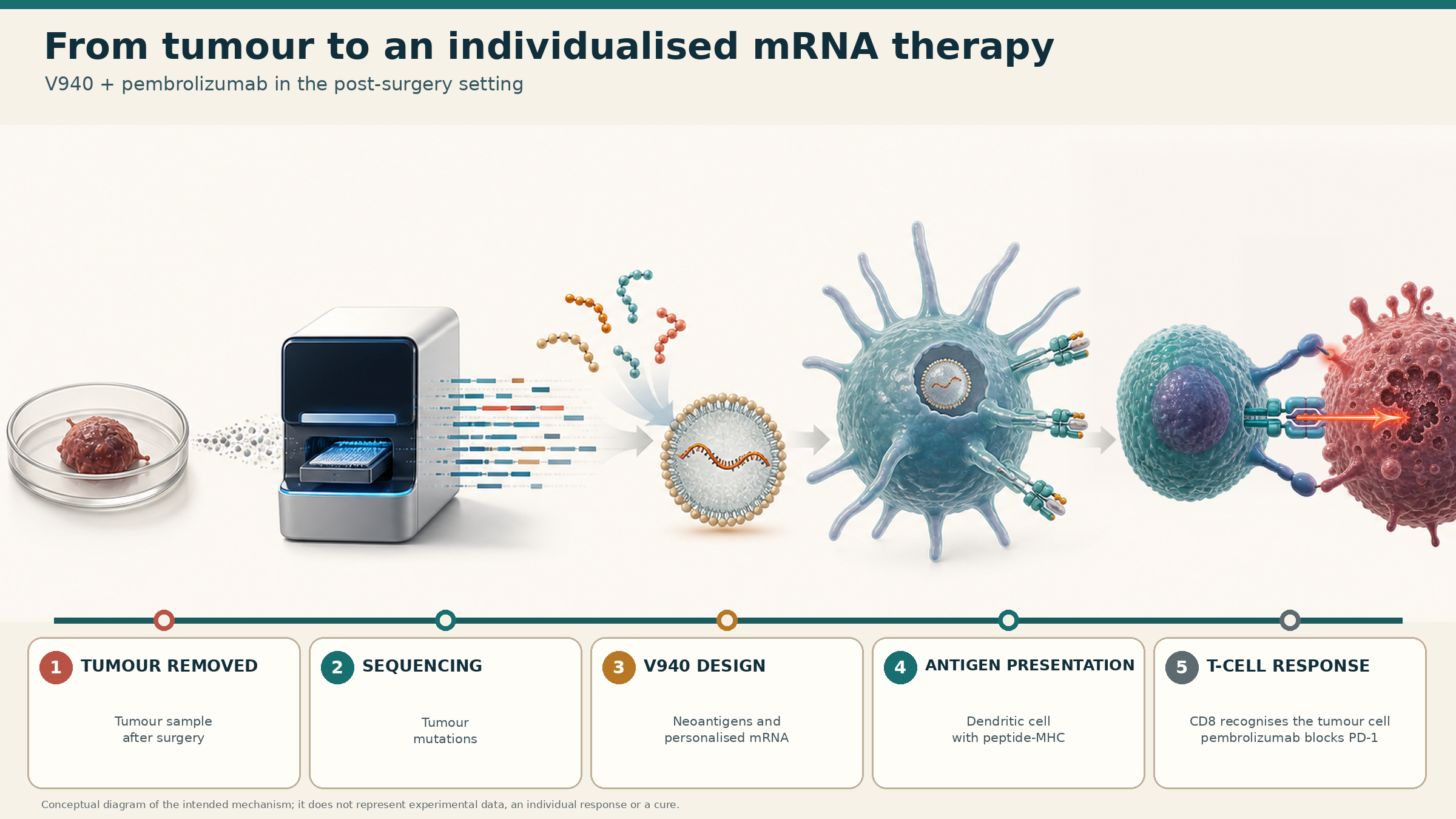
V940, also known as intismeran autogene and previously as mRNA-4157, is a personalised immunotherapy. The name is complicated; the idea is simpler. Although it is called a vaccine, it does not work like a vaccine that prevents an infection.
First, a sample of the tumour is analysed. Mutations in that tumour can create abnormal signals, known as neoantigens, that are not found in normal cells. These signals can help the immune system distinguish and attack cancer cells. A messenger RNA molecule is then manufactured with instructions that show the immune system a selection of those signals. The aim is to help T cells recognise the cells from that particular tumour. Earlier studies showed that personalised vaccines can produce immune responses against several neoantigens, although they used platforms and treatments different from V940 (Ott et al., 2017; Sahin et al., 2017).
V940 was not given on its own. It was combined with pembrolizumab, an immunotherapy that blocks PD-1, a signal that acts as a brake on T cells. Put simply, the vaccine tries to help the immune system identify the tumour, while pembrolizumab tries to release part of the immune response.
The intention is for that response to find and remove residual cancer cells before they can form another tumour. But the trial did not directly observe every residual cell or demonstrate that they had all disappeared. It measured something that can be assessed in the clinic: how long people remained alive without their melanoma returning.
It would therefore be wrong to attribute the entire result to the vaccine. In both Phase 2 and Phase 3, the combination was compared with pembrolizumab as the only active treatment. The trials estimate what happens when V940 is added to an active treatment, not the independent effect of each component (KEYNOTE-942; INTerpath-001).
What Phase 2 showed
A Phase 2 trial asks whether a treatment has enough activity, with acceptable safety, to justify a larger test. It can produce very interesting results, but it is not usually designed to settle whether the treatment works.
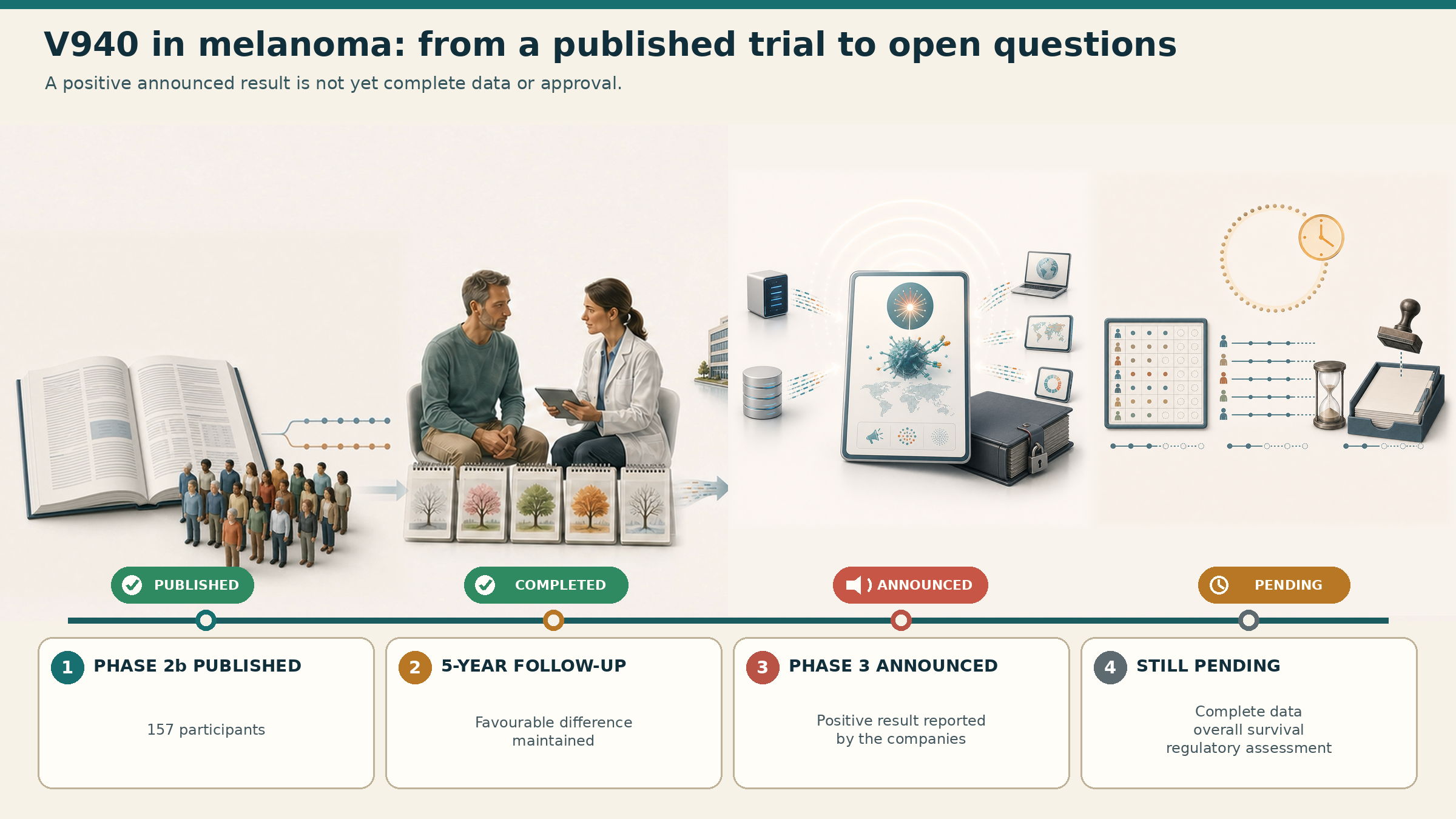
The Moderna and Merck Phase 2 trial, KEYNOTE-942, included 157 people with completely resected, high-risk stage IIIB–IV cutaneous melanoma. Put simply, they had a melanoma with a high risk of returning, but surgery had removed all disease that doctors could detect. A total of 107 people received V940 plus pembrolizumab; the other 50 received pembrolizumab alone (Weber et al., 2024).
In the analysis published in 2024, recurrence or death had occurred in 24 of the 107 people given the combination and in 20 of the 50 given pembrolizumab alone. At 18 months, the estimated proportion of people alive without recurrence was 79% with the combination and 62% with pembrolizumab alone (Weber et al., 2024).
The difference was striking and deserved attention, but the study was small and open-label: patients and investigators knew which treatment was being given. The first estimate was also uncertain enough to include the possibility that the apparent difference was due to chance. The result was therefore promising, not conclusive.
An update after five years of follow-up maintained a favourable difference both in time without recurrence and in time without distant metastasis. However, the analyses were described as descriptive, and an improvement in overall survival had still not been demonstrated (Weber et al., 2026).
It was not all good news. There was also toxicity. Treatment-related adverse events of grade 3 or higher (serious medical problems that may require intensive treatment and, in some cases, stopping therapy) occurred in 25% of people given the combination and 18% of those given pembrolizumab alone. The safety profile was considered manageable, but manageable does not mean harmless (Weber et al., 2024).
The trial was funded by Moderna in collaboration with Merck. This does not invalidate the findings, but it is part of the context in which they should be interpreted.
What we now know about Phase 3
A Phase 3 trial tries to confirm in many more people that a benefit is real and that it outweighs the risks. INTerpath-001 is also blinded: participants and the people assessing the outcomes do not know who receives V940 and who receives placebo. This design reduces the chance that expectations influence the assessment.
The study included about 1,100 people with completely resected, high-risk stage IIB–IV melanoma. In other words, no disease could be detected after surgery. It compares V940 plus pembrolizumab with placebo plus the same pembrolizumab treatment. Its primary endpoint is the length of time people remain free from recurrence. It also examines distant metastasis, overall survival, safety and quality of life (INTerpath-001, NCT05933577).
In August 2026, Moderna and Merck reported that a planned interim analysis had met the primary endpoint of recurrence-free survival and a key secondary endpoint of distant metastasis-free survival. According to the companies, both differences were statistically significant and clinically meaningful, and no new safety signals were seen (official release, 19 August 2026).
This is more informative than a vague “positive signal”: it means that the large trial reached two outcomes chosen in advance. But it is still a company announcement containing only headline results. Detailed trial data have not yet been published, the public trial record contains no results, and the study is continuing to assess other outcomes, including overall survival. The combination has not been approved on the basis of this result. The companies plan to present the data and discuss regulatory submissions with health authorities.
We can therefore say that the Phase 3 trial has produced a positive result. We cannot yet say how much it will benefit an individual patient, how long that benefit will last, whether it will help people live longer or whether it will ultimately change standard treatment.
Why preventing recurrence matters so much
After surgery, no detectable lesion may remain and yet the risk of recurrence can persist. One possible explanation is that cancer cells remain locally or in other tissues in numbers too small for routine methods to detect.
There is no routine clinical test that can guarantee that no disseminated cancer cell remains anywhere in the body. Circulating tumour DNA can provide evidence of residual disease in some settings, but a negative result cannot prove that no cell remains. It is important to separate what is known from what is inferred: KEYNOTE-942 and INTerpath-001 did not directly measure disseminated cells, dormancy or protective niches.
Adjuvant treatment aims to reduce the risk associated with this possible undetectable residual disease. That is difficult because the cells within a tumour are not all identical. Some targets may be present in many cells and others in only a fraction. Cancer cells can also lose mechanisms that the immune system needs in order to recognise them. Variation in neoantigens and the loss of antigen-presentation or interferon-response pathways are possible escape mechanisms, not an explanation proven for every recurrence (McGranahan et al., 2016; Zaretsky et al., 2016).
Cancer cells do not live alone
The tissue around a disseminated or residual cancer cell can also influence its survival and the immune response. Metastasis research distinguishes several related ideas. A pre-metastatic niche describes changes in an organ before cancer cells arrive. A metastatic niche is the environment of an established lesion. A dormant niche describes conditions that may help disseminated cells survive for long periods without forming a detectable lesion. These ideas can overlap, but they are not interchangeable (Aguirre-Ghiso, 2016).
These niches were not a target of V940, and the trials did not study their role. What we know about dormancy and the tumour microenvironment comes from clinical observations, animal models, cell experiments and mechanistic reviews. It is an important field of research, but it is not a clinical explanation already demonstrated for this vaccine (Goding et al., 2010; Aguirre-Ghiso, 2016).
Why the response will not be universal
For a personalised immunotherapy to work, immune cells must reach the cancer cell, recognise one of the selected targets and retain the ability to kill it. The cancer cell, in turn, must continue to display those targets. The surrounding tissue can add another barrier and reduce the effectiveness of the immune response.
Any of those conditions can fail. Some populations of cancer cells may not display the selected targets well. Others may become less visible to the immune system. An immunosuppressive environment may also make an effective response harder. These are plausible mechanisms; the V940 trials have not established which of them operated in each person whose melanoma returned.
It is therefore unrealistic to expect 100% efficacy. This does not make V940 less interesting. Improving immune recognition can be valuable without solving every mechanism that allows residual disease to persist. But it will not be enough in every case.
A research question: the cell and its surroundings
The biology of dormant disseminated cells raises another question. Could recurrence be controlled even better by targeting specific features of the environment that help residual cells survive, as well as improving immune recognition?
This is a research hypothesis. There is currently no validated combination that “switches off the niche”, and we do not know which target or treatment would be both effective and safe. Nor can we say that such an intervention would be necessary for every patient (Aguirre-Ghiso, 2016).
The question nevertheless connects this news with a central problem in metastasis. It is not enough to understand the cancer cell. We also need to understand the tissues in which it can persist and the conditions that limit immune surveillance.
Important news, with important gaps
V940 is a sophisticated way of personalising immunotherapy. Phase 2 justified a large confirmatory trial, and the companies have now announced that Phase 3 met its recurrence and distant-metastasis endpoints. This is an important advance.
But words matter. Delaying recurrence is not the same as curing melanoma. A positive company announcement is not a substitute for the complete data. And improving tumour recognition does not guarantee that every cell left after surgery will be removed.
The useful question is no longer whether Moderna has cured melanoma. It is how large the benefit is, which patients benefit, how long it lasts and how this approach might fit with other strategies that address the different mechanisms of residual disease.
Main sources
- Moderna and Merck. Phase 3 INTerpath-001 Trial Met Endpoints of RFS and DMFS (19 August 2026). Official release.
- Weber JS et al. The Lancet (2024). DOI 10.1016/S0140-6736(23)02268-7.
- Weber JS et al. Journal of Clinical Oncology (2026). DOI 10.1200/JCO-26-00835.
- Phase 2 trial: KEYNOTE-942, NCT03897881.
- Phase 3 trial: INTerpath-001, NCT05933577.
- Ott PA et al. Nature (2017). DOI 10.1038/nature22991.
- Sahin U et al. Nature (2017). DOI 10.1038/nature23003.
- Zaretsky JM et al. New England Journal of Medicine (2016). DOI 10.1056/NEJMoa1604958.
- McGranahan N et al. Science (2016). DOI 10.1126/science.aaf1490.
- Goding CR et al. Pigment Cell & Melanoma Research (2010). PMID 19843243.
- Aguirre-Ghiso JA. Pigment Cell & Melanoma Research (2016). DOI 10.1111/pcmr.12432.
This article is for general information and is based on public sources consulted up to 27 August 2026. It is not medical advice.
← Back to the blog