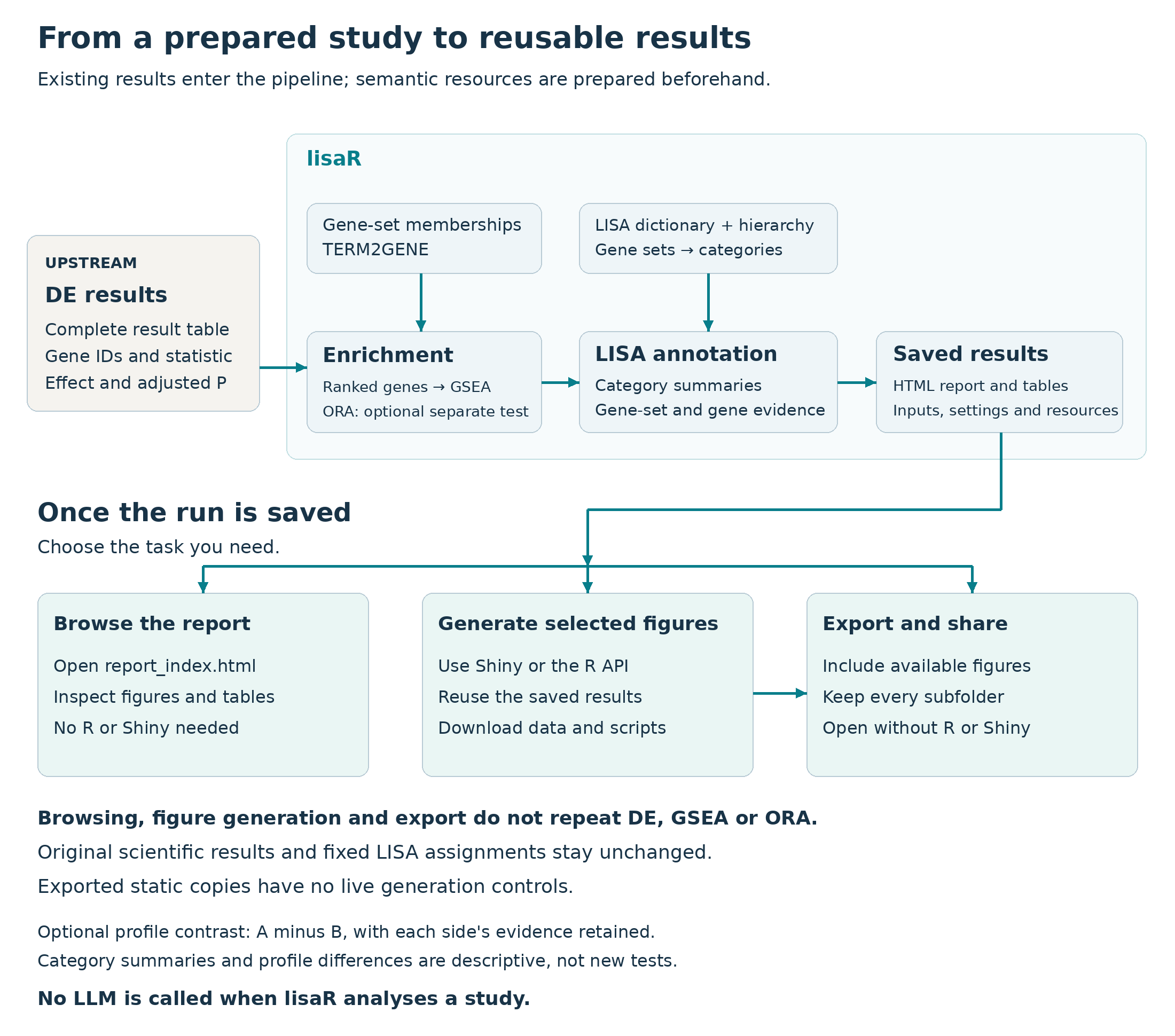
Prepared differential-expression results enter
enrichment and LISA organisation. Saved results then support browsing,
selected figure generation and portable export without repeating those
analyses.
LISA means LLM-Inferred Semantic Annotation. lisaR uses a LISA dictionary to organise gene-set enrichment results into broader biological themes. The dictionary is prepared before your study is analysed. During an ordinary run, lisaR applies the saved assignments locally and does not ask a language model to classify your results.
Differential expression is calculated upstream. lisaR runs the selected gene-set analyses, organises their results with the dictionary and category map, then saves the results and report. You can browse, generate selected figures or export from that saved run without repeating enrichment or changing its assignments. A comparison between two completed LISA profiles is descriptive; it does not fit another differential-expression model.
Open the workflow at full size.
A gene set is a defined group of genes, such as a Gene Ontology term or a named pathway. GSEA tests each selected gene set against the prepared ranking and reports quantities such as its normalised enrichment score (NES), adjusted p-value and leading edge.
LISA adds two levels of organisation:
| Level | Meaning |
|---|---|
| Category | A biological label that brings together related gene sets. |
| Supercategory | A broader group of related categories, used to order and display the report. |
For example, several gene sets can be assigned to one biological category, and several categories can appear under the same supercategory. A gene set may have more than one accepted category assignment. These assignments help navigation; they do not create independent statistical observations.
A category point summarises its significant assigned gene sets.
mean_NES is their descriptive mean at the configured GSEA
cutoff. It is not a category-level test. min_padj is the
smallest adjusted p-value among the member gene sets, not a category
false-discovery rate.
A separate category-inference layer assesses statistical support using raw gene-set P values. The category card reports its adjusted P and a lower bound on the number of enriched member sets. These do not turn mean NES into a significance test or establish a difference between conditions. See Statistical analysis for the method, hypothesis family and interpretation of d/N.
lisaR keeps biological membership and semantic organisation separate:
| Resource | What it supplies |
|---|---|
| TERM2GENE | The genes belonging to each gene set used by GSEA. |
| LISA dictionary | The accepted links from exact gene-set identifiers to categories. |
| Category map | Category names, their display order and their supercategories. |
The package includes core and expanded LISA dictionaries together with the category map. TERM2GENE membership for a real study is obtained and registered separately. A gene set can be tested by GSEA even if it has no LISA category; the report keeps that unmapped status in its complete tables.
The collection identifiers describe different views of those gene sets:
| Identifier | What it covers |
|---|---|
GOBP-C2 |
GO Biological Process together with selected curated pathways from MSigDB C2:CP. |
GOMF |
GO Molecular Function, describing molecular activities. |
GOCC |
GO Cellular Component, describing cellular locations and complexes. |
PATHWAYS |
A stricter signalling view of the GOBP-C2 gene-set space. |
HALLMARKS is a direct gene-set collection, not another
LISA category universe. Its results retain the original gene-set names
rather than using the semantic category assignments above.
The official LISA categories and gene-set assignments were defined before any reader’s study was run. For the GO-based collections, predefined category descriptions and gene-set metadata were presented for annotation. Separately recorded biological-fit scores from Qwen3.5, Gemma4, Mistral3.2 and Phi4-14b were then combined by the documented GO-family selection rule. Qwen3.5 and Gemma4 formed the anchor pair, while Mistral3.2 and Phi4-14b supplied supporting scores. The construction records also identify how missing scores were handled and where a small set of GOMF assignments received manual corrections.
In this context, a high score meant that a gene set fitted the category’s biological definition under its collection-specific rubric. For example, the GOMF rubric used 3 for a major function and 4 for a primary or canonical function, whereas GOCC assessed compartment identity. Under the ordinary rule, before any recorded manual correction, an assignment with anchor scores of 4 and 3 reached the core tier only when at least one supporting score was also at least 3. An assignment with both anchor scores of 3 reached the expanded tier, but not core.
PATHWAYS was built later with a different, name-first rule. A pathway’s name had to support the biological assignment; gene overlap alone was not enough. The PATHWAYS selection therefore cannot be described as a simple reuse of the GO-family rule.
The construction scores were ordinal judgements of biological fit. They were not probabilities, votes, GSEA weights or measurements from a study. The core dictionary retains the more stringent accepted assignments. The expanded dictionary contains those assignments plus the next accepted tier. Current runtime dictionaries keep the tier and gene-set-to-category links, not the historical construction score.
Some historical limits remain. The available records support the selection rules and their link to the distributed assignments, but they do not provide a complete original prompt and response trail for every GO annotation. The original MSigDB retrieval release is also unrecorded. These limits concern historical reconstruction, not the need for an LLM during analysis.
The dictionary construction guide gives the selection rules, the recorded corrections and the sources behind them. Use it to examine how an assignment entered core or expanded; you do not need to repeat that construction to analyse a study.
The built-in dictionaries are fixed package resources. Choosing core or expanded selects one of those reviewed assignment sets; it does not rebuild the dictionary.
A custom dictionary is useful when your study needs a different biological classification, for example a laboratory-specific category system or a specialised collection. A custom bundle supplies its own gene-set-to-category table, category map and compatible TERM2GENE membership. It receives a separate resource identity and does not replace or silently modify a built-in dictionary.
The Custom dictionaries and supercategories guide shows the required table relationships and how to validate, register and select a custom bundle.
Differential expression is prepared upstream. Each analysis declares its comparison and what a positive signed ranking value means. A positive NES means enrichment towards that declared end of the ranking; it has no direction-independent biological meaning.
lisaR runs GSEA on the selected TERM2GENE membership, applies the chosen dictionary and writes the report. Over-representation analysis (ORA) is an optional analysis of a thresholded gene list and background. Its overlap counts and adjusted p-values are different from GSEA quantities and leading edges.
The report keeps the underlying GSEA results, complete differential-expression records where supplied and gene-set memberships alongside the category views. This lets you move from a category summary back to the gene sets and genes that contribute to it.
A saved standard report can be opened in a browser and explored without R. Keep the report folder together so that its pages, figures and downloads retain their relative links. The static report guide explains the category views, evidence tables and existing downloads.
For interactive work, open the saved run in R or RStudio:
The Shiny interface lets you browse the saved report and choose the figure you want to generate. Use Generate for that specific request. Opening a category, searching for a gene or changing a selection does not generate a figure. The generated figure can include image, data and R-script downloads where available.
Saving an expanded report copies the standard report together with
figures that were already available when export began. The copied
report_index.html can then be opened without R or Shiny.
Live Shiny controls are not part of that static copy. These actions do
not recompute differential expression, GSEA or ORA, and they do not
modify the original saved analysis. See the separate Shiny guide for the current workflow.
KEGG-derived gene sets in TERM2GENE can contribute to enrichment like other selected gene sets. A native KEGG pathway map is a separate optional product that needs an authorised local snapshot. Having KEGG gene-set memberships does not itself provide that map or permission to retrieve one.
Continue with Quick Start for the installed sample project, Preparing DE inputs for your own results or Resources and provenance for external memberships and their terms.